
Your Perfect Pitching Staff
Links, News, and More

THE PERFECT PITCHING STAFF ARTICLE
I wanted this annual story to go in The Guide this year, but I got caught up writing profiles and ran out of time. Now, finally, it’s published online for Guide buyers. You can find it following the link and password published in The Guide on page 4. Paid newsletter subscribers will find the page linked here, with the password after the paywall in today’s newsletter.
I started writing about the Perfect Pitching Staff in 2014. I even included the Most Profitable Pitchers chart from 2013 in that story:
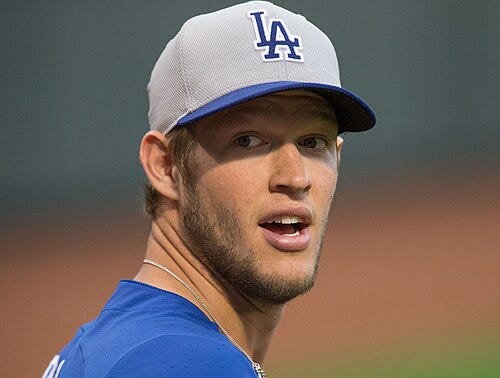
Clayton Kershaw in 2013. Photo by Keith Allison from Owings Mills, USA
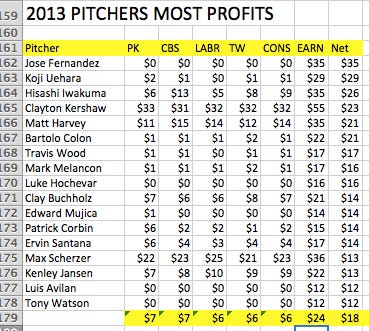
It very much looks like the chart from 2025:
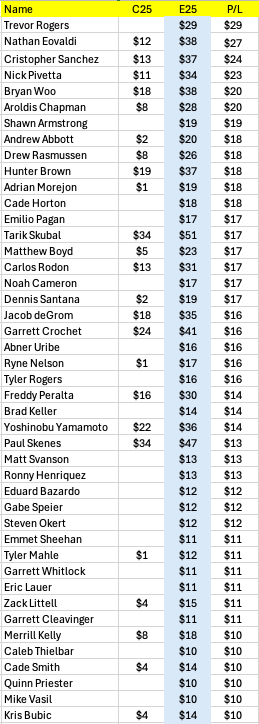
There were 32 pitchers who earned $12 or more in profit last year, while only 17 in 2013. I’m not sure why that would be, though the composition of pitching staffs is much different now than it was then. It appears there are more setup guys on the list now than there were back then.
The foundation of The Perfect Pitching Staff plan was built on all the blank cells in the 2025 column C25. That’s the average draft cost of the pitcher in a number of leagues, including the CBS, LABR, and Tout Wars expert leagues. With so many blanks the question has to be, Why pay for pitching when so much of it comes for free?
One chart I didn’t include in the article is a list of last year’s players who cost $5 or less by their earnings. These earned $10 of profit or more.
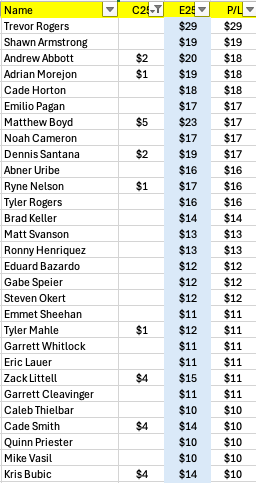
With all that free or near free loot you build a perfect pitching staff by buying an ace, a closer, paying what you must, and then filling in in the endgame with cheap guys. The goal is to spend less than 30 percent of your budget on pitching. The more less the better.
Read more about it here (for owners of the Guide and paid newsletter subscribers only).
SPRING TRAINING HAPPENINGS
Jack Leiter, adds a cutter: He says he wants to be more efficient. He learned the grip from Garrett Crochet over the winter! Leiter was supposed to be an ace coming out of college but he’s struggled by walking too many hitters. It’s easier blowing away college hitters than pros. Adding a pitch doesn’t guarantee success, but his control improvement last year was a first step to possibly taking a big step up.
Sebastian Walcott, to miss season (or most of it): A top prospect, though more likely for 2027 than this year, Walcott had internal brace surgery and is expected to be out until August, at least. His prospect status dimmed a bit last year because his power didn’t come with him to Double-A, but he was just 19 years old. Give him a break. Unfortunately his elbow is going to do just that, but he’ll still be young for his level when he returns even if he misses all of this year.
Romy Gonzalez, to miss season opener: He’s treating a bum shoulder with platelet rich injections and is coming along slowly. This increases the opportunity for Isiah Kiner-Falefa and/or Andrew Monasterio to stick backing up Caleb Durbin.
Kyle Karros, bulks up: The Rockies say his weak performance last year was because he was playing below his ideal weight and was fatigued. So, in the offseason he put on 20 pounds and is now ready to mash. He’s a good defender with good discipline and zone judgement, so if he can hit the ball harder he might be a bit of a surprise.
Josh Smith, second base starter?: It makes sense against righties, but he was terrible last year against lefties, so maybe a platoon. The funny thing is that in a fantasy leagues with 15 games played at a position for eligibility, the only position other than catcher he doesn’t qualify for is second base.
Brandon Woodruff, to miss time?: I’ve been high on Woodruff this year, but I’m backing off just a bit. Last season ended with a lat strain and he’s still bothered by it. He’s also talking about how important it is to be healthy for the end of the season, rather than the beginning. Based on the way he pitched last year when he pitched I’m still keen on him, but there is a fair chance we’re going to see less of him than we hoped.
Bryan Abreu, closer?: Josh Hader is expected to start the season on the IL, which should put Abreu in the closer role, at least for a time. That other Bryan, King, could also close games, so this might not be a pure play one would hope for.
Rhys Hoskins, signs with Guardians: It’s only a minor league deal so there is still a chance that CJ Kayfus ends up in the mix at first base, but if Hoskins lands a job the roles in Cleveland’s first base and left field jobs will be muddy at best. And reports are that the Hoskins deal is minor league only until the Guardians can clear a spot on their 40-man roster. At the least, Kyle Manzardo would seem to lose at bats against lefties. And Kayfus seems likely to be kayoed. At least for a time.
Michael Conforto, signs with Cubs: It’s a real minor league deal, so he’s going to have to do better than he did last year to win a spot on the big league roster. Even then he’s looking at a platoonist’s number of at bats at best.
RECOMMENDED
Dave Gonos writes about baseball cards. I loved the cards when I was a kid and have a residual affection for them today, though I don’t collect them. But Dave is a fun writer. In today’s newsletter he writes about rookie quad cards, which back in the day featured four rookies (and sometimes five) on one card. The card Gonos writes about today has Mickey Klutts and U.L. Washington, but is of more interest because it also has Paul Molitor and Alan Trammel, who went on to the Hall of Fame.

Dave says Topps released 62 quad cards and only six players on them went to the Hall. That’s six out of 248 players, a rate of 2.4 percent. This sounds low, but I asked Gemini what percentage of players in the 70s were inducted and, of course, there are a few different ways to look at it. If you look at the pool of all players, in the expansion era about 1 percent of players were inducted, while if you look at regular players in the 1970s, those with 5,000 at bats in their career, about 6.9 percent were inducted, while 3.5 percent of regular pitchers got to Cooperstown.
To read more of Dave’s writing subscribe.
THE STORE
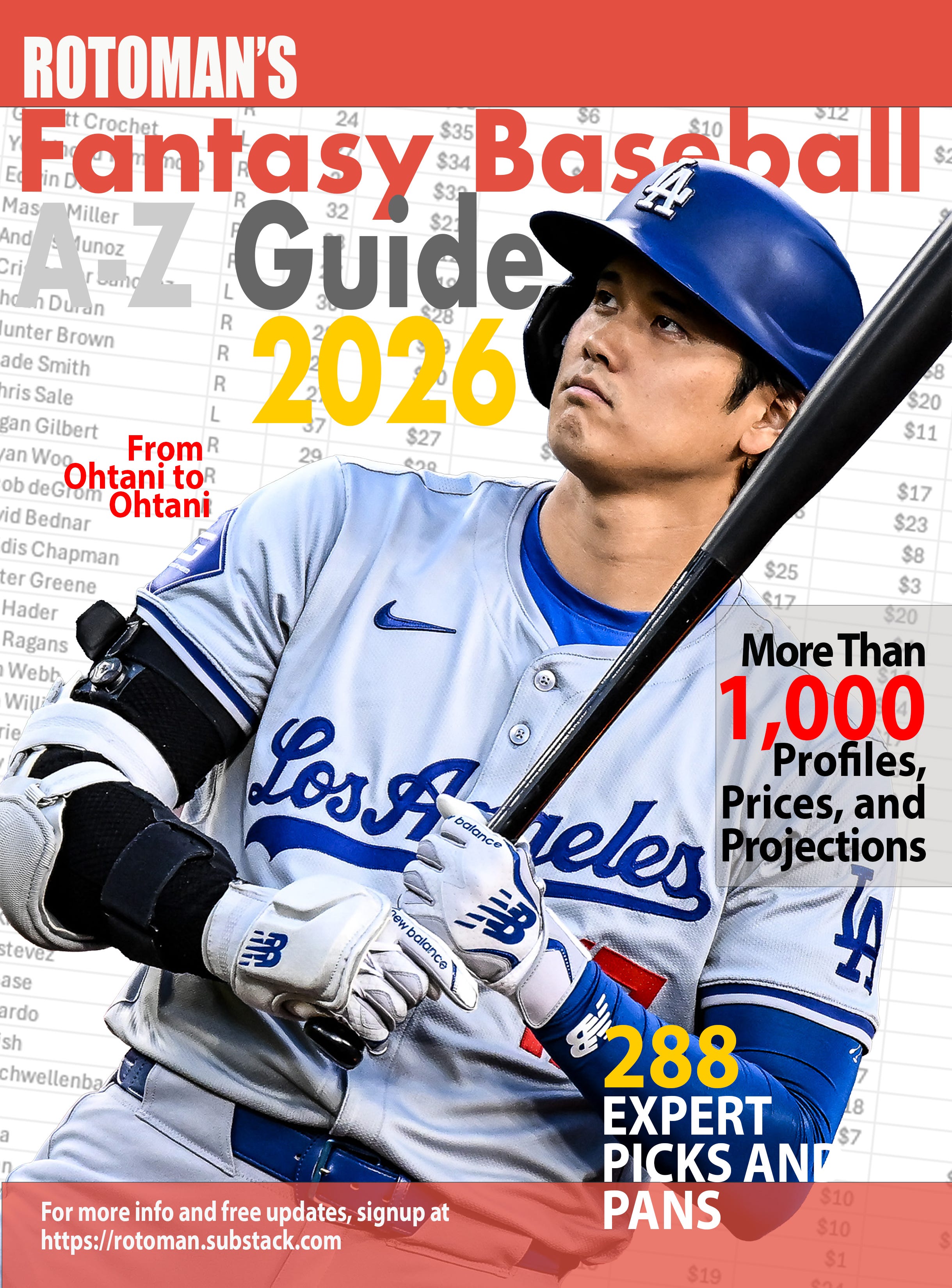
Rotoman’s Fantasy Baseball Guide A-Z 2026 is for sale. Usually $20, it’s ON SALE price is: $19.11
The Kindle version is out, too! Price: $9.99
You can order your print and Kindle versions using this link.
If you’ve read The Guide and you like it please consider leaving a review on Amazon. The link above takes you to the page. Good reviews help get the word out. So do five-star ratings. Thank you.
If you’d prefer the PDF version, which you can download as soon as the payment goes through, click here. Price: $12
There is a non-Amazon version. Paypal $20 to askrotoman@gmail.com and I’ll mail you a copy when I get them. That should be this week, they shipped my way over the weekend. You should also be able to order through your local bookstore, though I don’t know how long that takes. I see you can buy the 2025 edition on Walmart’s and Target’s websites. Don’t do it, it is cheaper on Amazon.
HOUSEKEEPING
If you wanted to follow the SOLDS draft yesterday, blame me for the bad link to the draft board. The finished draft results are here. Sorry for the error.
Coming up soon is the Rookie preview, as well as Team by Team position battles. Send questions about which position battles you’re interested in here:
If you buy the so-called annual subscription I will at some point notice and email you the PDF of the Guide. Feel free to email me as askrotoman@gmail.com and let me know you signed up for the $40 plan. I’ll send the pdf as soon as I see the email.
If you buy a monthly subscription you can pay once and be a member right up until Opening Day. You get the Master Sheet and access to member only posts, but not the PDF.
Send your questions to Ask Rotoman.
Have a great week.
Sincerely,
The Master Sheet for paid subscribers is after the paywall!
The paywall is now.
